


Violate and breach both describe failing to follow a rule, law, agreement, or obligation. However, they are not always interchangeable. Violate generally means to break or disregard a rule, law, right, or principle. Breach often means to break a formal duty, agreement, contract, or obligation. For example, you can violate someone’s privacy or breach a contract, but the most natural word depends on what has been broken.
What Is the Difference Between Violate and Breach?
The main difference between violate and breach is the type of rule, right, agreement, or responsibility being broken.
Violate is generally used when someone acts against a law, rule, right, policy, restriction, or personal boundary. Breach is especially common when someone breaks a contract, agreement, duty, promise, confidentiality requirement, or security system.
Consider these examples:
- The driver violated the traffic regulations.
- The supplier breached the contract.
- The website violated users’ privacy.
- The employee breached the confidentiality agreement.
Both words can describe breaking laws and agreements. However, their usual word combinations differ. Choosing the right word makes your English more precise and natural.
Can Violate and Breach Be Used Interchangeably?
Sometimes, yes. Both verbs can describe breaking an agreement, law, or promise.
For example:
- The company violated the agreement.
- The company breached the agreement.
Both sentences are grammatically correct. However, breached the agreement is generally the more established choice in formal contract-related writing.
Similarly, violate a law is a natural and widely used expression. Breach a law is also possible, particularly in legal and British English contexts.
The important point is that the words overlap in meaning but have different usage patterns. They are not interchangeable in every situation.
Why the Difference Between Violate and Breach Matters
Choosing between these words matters because they can describe different types of wrongdoing.
In everyday communication, using the wrong word may make your sentence sound unusual. In professional or legal writing, it can also make your meaning less precise.
Consider three situations:
- Legal writing: A person violates a regulation, while a business breaches a contractual obligation. The distinction helps identify the type of requirement involved.
- Business communication: A supplier that fails to deliver according to an agreement may have breached the contract. Calling the same situation a violation may be understandable, but it is less conventional.
- Privacy and cybersecurity: An organisation may violate someone’s privacy and experience a data breach. These expressions describe related but different aspects of an incident.
A particularly important distinction is that a breach does not automatically mean a criminal offence has occurred. Whether an action is illegal, negligent, intentional, or subject to a particular penalty depends on the applicable law and circumstances.
The Core Rule: Violate vs. Breach
VIOLATE
Break or disregard a rule, law, right, policy, or boundary.
Examples: violate a law, violate someone’s rights, violate privacy, violate company rules.
BREACH
Break an agreement, contract, duty, promise, trust, or security barrier.
Examples: breach a contract, breach confidentiality, breach a duty, breach security.
Easy way to remember:
- If someone fails to respect a rule or right, consider violate.
- If someone fails to fulfil an agreement or obligation, consider breach.
This is a useful guideline, not an absolute grammatical rule.
How to Use Violate and Breach
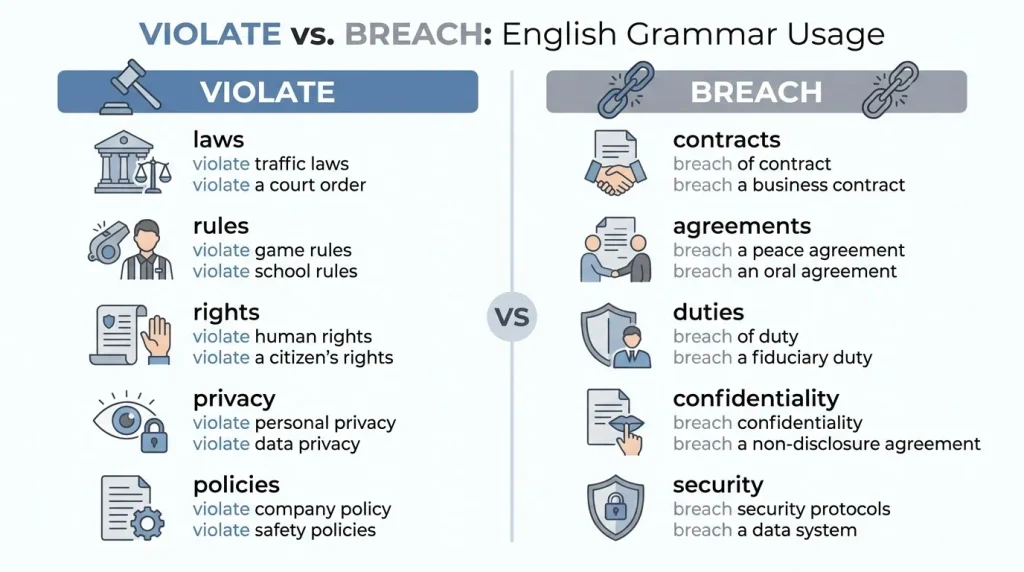
Understanding their grammatical patterns and common combinations will help you choose the correct word.
1. How to Use Violate
Violate is a transitive verb. A transitive verb normally takes a direct object, meaning the word that receives the action.
The basic structure is:
Subject + violate + object
Examples:
- The driver violated the speed limit.
- The company violated environmental regulations.
- The employee violated workplace policies.
- The government violated citizens’ rights.
The word is particularly useful when the subject has failed to respect an established rule, protection, or standard.
Common combinations include:
| Expression | Example |
|---|---|
| Violate the law | The business violated the law. |
| Violate a rule | He violated the school rule. |
| Violate someone’s rights | The decision violated her rights. |
| Violate privacy | The application violated users’ privacy. |
| Violate a policy | The employee violated company policy. |
| Violate a restriction | The factory violated the restrictions. |
| Violate a principle | The proposal violated basic ethical principles. |
| Violate a boundary | He violated her personal boundaries. |
Important: You can also use violate with agreements, contracts, promises, and obligations. The word is not restricted to laws and rules.
For example:
- The organisation violated the terms of the agreement.
- He violated his promise to the team.
These sentences are grammatically correct, although breached the agreement and broke his promise may be more natural choices in particular contexts.
2. How to Use Breach
Breach can function as both a verb and a noun.
As a verb, it means to break or fail to fulfil an obligation, agreement, or requirement.
The basic structure is:
Subject + breach + object
Examples:
- The contractor breached the agreement.
- The employee breached confidentiality.
- The company breached its contractual obligations.
- The organisation breached its security procedures.
As a noun, breach refers to the act or result of breaking an obligation, agreement, or protective barrier.
Common noun structures include:
A breach of + noun
- A breach of contract
- A breach of trust
- A breach of confidentiality
- A breach of duty
- A breach of security
- A breach of privacy
Examples:
- The court examined the breach of contract.
- The company reported a serious breach of security.
- Sharing confidential information was a breach of trust.
Remember: Breach is not limited to legal agreements. It can also describe a physical opening in a wall or barrier.
For example:
- The soldiers discovered a breach in the defensive wall.
- Heavy rain caused a breach in the river embankment.
This physical meaning is different from the legal and professional meaning.
3. Understand the Difference Between Violate and Violation
Violate is a verb, while violation is its noun form.
Compare:
- The company violated the policy.
- The company committed a violation of the policy.
Both sentences describe the same general situation, but their grammatical structures differ.
| Word | Part of speech | Example |
|---|---|---|
| Violate | Verb | They violated the regulation. |
| Violation | Noun | It was a serious violation. |
| Breach | Verb | They breached the contract. |
| Breach | Noun | It was a serious breach. |
Do not write a violate when you need a noun. Use a violation instead.
4. Understand the Difference Between Breach and Breached
Breach is the base form of the verb and can also be a noun. Breached is its past-tense and past-participle form.
Examples:
- Present: The company may breach the contract.
- Past: The company breached the contract.
- Present perfect: The company has breached the contract.
- Noun: The breach caused financial losses.
The same principle applies to violate:
- Present: They violate the regulations.
- Past: They violated the regulations.
- Present perfect: They have violated the regulations.
- Noun: Their actions constituted a violation.
5. When Can You Use Both Words?
There are situations where both words are acceptable, particularly when discussing laws, agreements, and promises.
For example:
- The organisation violated the terms of the agreement.
- The organisation breached the terms of the agreement.
Both sentences are correct. However, the second is generally more conventional in contract-related writing.
Another example:
- The company violated the law.
- The company breached the law.
Both can be found in English, but violated the law is the more familiar general expression in many contexts.
The best choice depends on the object, the intended emphasis, and the conventions of the subject area.
Correct Examples of Violate and Breach
The following examples show how these words work in different situations.
1. Everyday Conversation
Violate:
“You’re violating my personal space. Please step back.”
The speaker uses violating because someone is crossing a personal boundary.
Breach:
“He breached my trust when he shared my secret.”
Here, breached describes the damage to a relationship caused by breaking an expectation of trust.
2. Workplace Communication
Violate:
“The employee violated the company’s attendance policy by repeatedly arriving late.”
The word refers to breaking an established workplace rule.
Breach:
“The manager breached the confidentiality agreement by sharing the employee’s private information.”
The word refers to failing to respect a formal confidentiality obligation.
3. Business Emails
Violate:
“We believe that the proposed changes may violate the terms of our operating policy.”
This is appropriate when discussing whether a proposal conflicts with an established policy.
Breach:
“Please investigate whether the supplier has breached its contractual obligations.”
This is a natural choice in formal business correspondence about a possible failure to meet contractual responsibilities.
4. Academic Writing
Violate:
“The researchers violated ethical guidelines by collecting information without proper consent.”
The word identifies conduct that conflicts with research ethics.
Breach:
“The institution was accused of a breach of its duty to protect student information.”
The noun breach identifies a possible failure to fulfil a responsibility.
5. School and Education
Violate:
“The student violated the examination rules by using an unauthorised device.”
The student failed to follow a specific rule.
Breach:
“The school investigated a breach of confidentiality after examination results were shared prematurely.”
The noun describes a failure to maintain confidential information.
6. Social Media
Violate:
“Posting someone’s private photographs without permission can violate their privacy.”
The sentence focuses on someone’s right to privacy.
Breach:
“The platform announced a data breach that exposed users’ personal information.”
The expression describes a security incident involving unauthorised access or disclosure.
7. Legal Context
Violate:
“The defendant was accused of violating the court’s order.”
The verb describes acting against a legal requirement.
Breach:
“The landlord was accused of breaching the tenancy agreement.”
The verb describes an alleged failure to follow an agreement.
8. Personal Relationships
Violate:
“Repeatedly reading someone’s private messages without permission violates their privacy.”
The focus is on disregarding a personal boundary.
Breach:
“She felt that cancelling the promise without explanation was a breach of trust.”
The expression describes damage to a relationship built on trust.
9. Technology and Cybersecurity
Violate:
“The application violated its own privacy policy by collecting information without proper authorisation.”
The focus is on conduct that conflicts with a stated policy.
Breach:
“The attackers breached the company’s network and accessed confidential files.”
Here, breached describes breaking through a security barrier.
10. Government and Public Policy
Violate:
“The proposed legislation could violate citizens’ constitutional rights.”
The word refers to the possible infringement of protected rights.
Breach:
“The government was accused of a breach of its international obligations.”
The noun refers to an alleged failure to meet an established responsibility.
Incorrect vs. Correct: Violate vs. Breach
Not every sentence containing these words is grammatically wrong simply because another word sounds more natural. Some examples below are genuinely incorrect; others are understandable but less idiomatic or less precise.
| ❌ Incorrect or less natural | ✅ Better choice | Why |
|---|---|---|
| The supplier violated the contract. (less conventional in formal contract writing) | The supplier breached the contract. | Breach a contract is the established legal and business collocation. |
| The driver breached the speed limit. (less natural) | The driver violated the speed limit. | Speed limits are regulations, so violate is the usual choice. |
| The employee made a violate of company policy. | The employee committed a violation of company policy. | Violate is a verb; violation is the noun. |
| The company committed a breach the agreement. | The company committed a breach of the agreement. | The noun breach normally takes of before the object in this construction. |
| The employee breach the confidentiality agreement yesterday. | The employee breached the confidentiality agreement yesterday. | A past event requires the past-tense form breached. |
| The organisation has violate the regulations. | The organisation has violated the regulations. | The present perfect requires the past participle violated. |
| He breached her personal space. (less natural in ordinary conversation) | He violated her personal space. | Violate personal space is the more established expression. |
| The company breached its environmental policy. (possible, but less conventional) | The company violated its environmental policy. | Violate a policy is generally the more natural combination. |
| The organisation experienced a violate of privacy. | The organisation experienced a violation of privacy. | The noun form is required after the article a. |
| The contractor was accused of a breach the contract. | The contractor was accused of a breach of contract. | The standard noun construction is a breach of contract. |
| The hacker violated the company’s security barrier. (less precise) | The hacker breached the company’s security barrier. | Breach naturally describes breaking through a protective barrier. |
| The employee breached the school attendance rule. (less natural) | The employee violated the school attendance rule. | Violate a rule is the more familiar collocation. |
A useful lesson from these corrections is that grammar and natural usage are not identical. A sentence can be grammatically possible but still be an unusual choice for a particular context.
Why People Confuse Violate and Breach
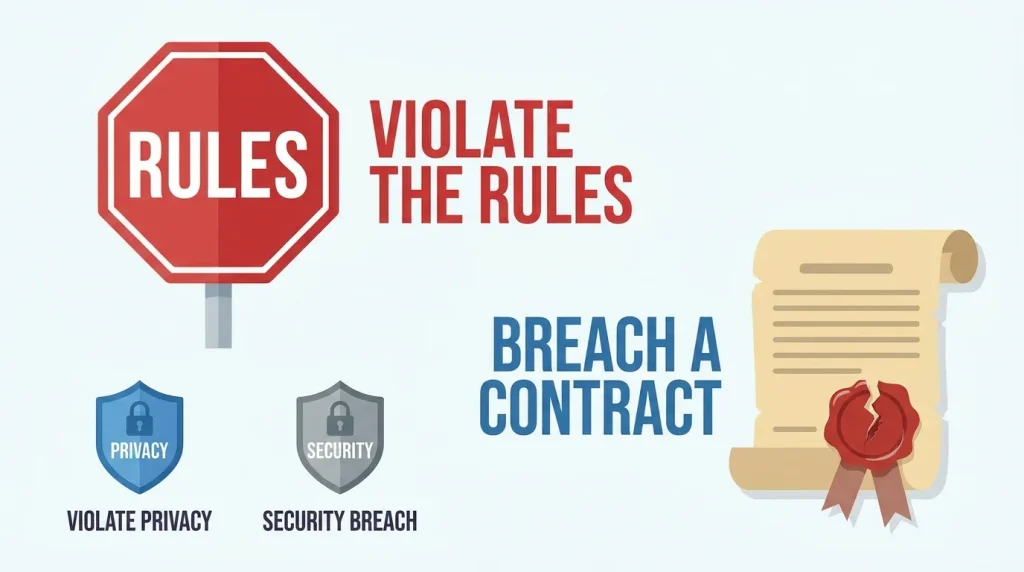
There are several reasons English learners and even experienced writers confuse these two words.
1. Their Meanings Overlap
Both words can describe breaking a law, agreement, promise, or rule.
For example:
- The company violated the agreement.
- The company breached the agreement.
Because both sentences communicate a similar idea, learners may assume the words are interchangeable everywhere.
However, their common combinations differ. English speakers often choose words based on established expressions rather than dictionary definitions alone.
2. They Are Used in Similar Legal Contexts
Both words appear frequently in legal, professional, and business writing.
For example:
- Violation of the law
- Breach of the law
- Violation of an agreement
- Breach of an agreement
The overlap makes the distinction harder to recognise. The solution is to learn the typical expressions used in each context rather than memorising only their meanings.
3. Learners Overgeneralise the Rule
A common learning mistake is assuming that violate always refers to laws and breach always refers to contracts.
This is too restrictive.
You can violate an agreement, breach a law, and breach someone’s trust. Both words have overlapping meanings, although certain combinations are more conventional.
4. Spellcheck and Autocomplete Cannot Always Identify the Problem
Grammar and spelling tools may accept both words because both are correctly spelled and grammatically possible in many sentences.
For example:
“The supplier violated the contract.”
A spelling checker may find no problem. However, a professional editor might prefer:
“The supplier breached the contract.”
The difference is not necessarily a spelling or grammar error. It is a matter of word choice and conventional usage.
5. Translation Interference
Some languages use one general word for several meanings covered by violate, breach, infringe, and break in English.
When learners translate directly, they may choose a word that communicates the general meaning but does not fit the English expression naturally.
For example, someone might translate a phrase meaning “break a rule” literally and use breach where violate would be more natural.
The best solution is to learn complete word combinations:
- Violate a rule.
- Violate someone’s rights.
- Breach a contract.
- Breach confidentiality.
- Breach a duty.
Learning phrases is often more effective than learning isolated vocabulary.
ALSO CHECKOUT: Has Run vs. Has Ran: Which Is Grammatically Correct?
Common Mistakes Checklist
Use this checklist when editing sentences containing violate or breach.
- Using violate as a noun: Write a violation, not a violate. The first is the noun; the second is a verb.
- Using breach when violate is more natural: Prefer violate a traffic rule rather than breach a traffic rule in ordinary English.
- Using violate when breach is more conventional: Prefer breach a contract in formal contract-related writing.
- Forgetting the preposition of: Write a breach of contract, not a breach contract.
- Confusing verb and noun forms: Write they breached the agreement but a breach of the agreement.
- Using the wrong tense: Write violated for a completed past action and has violated for the present perfect.
- Assuming breach always means a legal offence: A breach can be contractual, professional, personal, physical, or security-related.
- Assuming violate only applies to laws: It can also describe disregarding privacy, boundaries, policies, and ethical principles.
- Ignoring natural word combinations: A sentence can be grammatically correct but still sound less natural than another available expression.
- Treating every breach as intentional: A breach can occur through negligence, oversight, or deliberate conduct. Intent depends on the circumstances.
ALSO SEE: Has Run vs. Has Ran: Which Is Grammatically Correct?
Violate vs. Breach in Real English
The distinction between grammatical correctness and natural usage is particularly important here. Both words have overlapping definitions, so the best choice often depends on the noun that follows them.
1. Grammatically Correct and Natural
“The driver violated the traffic regulations.”
This is grammatically correct and natural everyday English. Violated works well because the driver acted against established regulations. It is a familiar expression in news reporting, legal discussions, and ordinary conversation. You could also say that the driver broke the traffic regulations, which is a simpler and less formal alternative.
2. Grammatically Possible but Less Natural
“The driver breached the traffic regulations.”
This sentence is understandable and grammatically possible. However, it is less conventional in ordinary conversation than violated the traffic regulations. The word breach is more strongly associated with obligations, agreements, and protective barriers. In this situation, most writers would find violated a more straightforward choice.
3. Natural and Appropriate in Professional English
“The supplier breached the contract.”
This is a natural and established expression in business and legal writing. It describes a failure to meet an obligation set out in a contract. Although violated the contract is also grammatically possible, breached the contract is generally the preferred collocation in formal contract-related contexts.
4. Natural in Personal and Privacy Contexts
“Sharing her private messages without permission violated her privacy.”
This is a natural expression because violate someone’s privacy is an established combination. It focuses on the failure to respect a person’s private information or personal boundaries. Saying breach her privacy is also possible, especially in formal or journalistic contexts, but violate her privacy is a familiar choice.
5. Natural in Cybersecurity
“The company suffered a data breach.”
This is a standard expression in technology, cybersecurity, and business communication. It describes an incident involving unauthorised access to, disclosure of, or compromise of data. Saying that someone violated the data would not communicate the same idea naturally. The established term is data breach.
American vs. British English: Is There a Difference?
There is no major difference in the basic meanings of violate and breach between American and British English.
Both varieties use expressions such as:
- Violate the law.
- Violate someone’s rights.
- Breach a contract.
- Breach confidentiality.
- Breach of trust.
- Data breach.
However, legal terminology and preferred expressions can vary between jurisdictions. Breach of contract is a standard legal expression in both American and British English, while the precise legal consequences and terminology depend on the applicable legal system.
There is also a difference in some associated expressions. For example, breach of the peace is an established legal expression in British and American contexts, although its legal scope is not identical.
For general English writing, you do not need to change the basic distinction based on whether you are writing for an American or British audience.
Formal vs. Informal Usage
Both words are relatively formal compared with the everyday verb break.
However, their suitability depends on the context.
| Situation | Recommended expression | Register |
|---|---|---|
| Casual conversation | Break a rule | Informal |
| Everyday conversation | Violate someone’s privacy | Neutral to formal |
| Business contracts | Breach a contract | Formal |
| Workplace policies | Violate company policy | Professional |
| Legal documents | Breach a contractual obligation | Formal/legal |
| Cybersecurity reports | Data breach | Technical/professional |
| Academic writing | Violate ethical guidelines | Academic/formal |
| Personal relationships | Breach of trust | Neutral to formal |
Can You Use Violate in Everyday Conversation?
Yes. Although violate can sound formal, it is perfectly acceptable in everyday English.
For example:
- “You’re violating my privacy.”
- “He violated the rules again.”
- “That decision violates our agreement.”
In casual conversation, you could often use break instead:
- “He broke the rules again.”
- “You’re invading my privacy.”
The choice depends on how formal or precise you want to sound.
Is Breach Too Formal for Everyday English?
Not necessarily. People use breach in ordinary conversations, particularly in familiar expressions such as breach of trust and security breach.
However, it is more common in professional, legal, and technical contexts than in casual descriptions of simple rule-breaking.
For example, “You breached the agreement” sounds more formal than “You broke our agreement.”
Violate vs. Breach: Comparison Table
| Feature | Violate | Breach |
|---|---|---|
| Main meaning | Disregard or act against something | Break or fail to fulfil something |
| Part of speech | Verb | Verb and noun |
| Noun form | Violation | Breach |
| Laws | Very common | Also possible |
| Rules | Very common | Possible, but context-dependent |
| Contracts | Correct | Especially common |
| Agreements | Correct | Especially common |
| Rights | Very common | Possible in some contexts |
| Privacy | Very common | Also used |
| Confidentiality | Possible | Very common |
| Trust | Possible | Very common |
| Security | Used for rule-breaking | Common for security incidents |
| Physical barriers | Less common | Common |
| Formality | Neutral to formal | Neutral to formal |
| Common expression | Violate the law | Breach of contract |
The most important difference is not that one word is always correct and the other is always wrong. It is that each word has established combinations that make it more suitable in particular contexts.
Real-Life Situations: Which Word Should You Choose?
Here are five practical situations showing how to choose between violate and breach.
1. During a Job Interview
Interviewer: “What would you do if a colleague shared confidential company information?”
Candidate: “I would report the incident because sharing that information could breach the company’s confidentiality agreement.”
Why breach? The situation involves a specific obligation to keep information confidential.
2. During a Business Meeting
Manager: “The proposed marketing campaign uses customer information without permission.”
Legal Adviser: “That could violate our privacy policy and applicable data protection requirements.”
Why violate? The focus is on acting against privacy rules and legal protections.
3. Writing a Formal Email
Subject: Contractual obligations
“The supplier has failed to meet the agreed delivery conditions. We are reviewing whether this failure constitutes a breach of contract.”
Why breach? The email concerns a possible failure to fulfil contractual obligations.
4. Sending a Text Message
Person A: “Why did you read my messages?”
Person B: “I’m sorry. I shouldn’t have violated your privacy.”
Why violate? The expression naturally describes disregarding someone’s personal privacy.
5. Taking an English Examination
Question: Choose the most natural word.
“The employee was dismissed for ______ the company’s safety regulations.”
- A. Breaching
- B. Violating
Correct answer: B
Explanation: Violating safety regulations is the more natural and conventional expression because the employee acted against established rules.
Quick Quiz: Test Your Understanding
Choose violate or breach to complete each sentence.
Five-question practice
0/5 answered
1. The company was accused of ______ the employment contract.violatingbreaching
2. The driver ______ the speed limit.violatedbreached
3. Sharing confidential information can be a ______ of trust.violationbreach
4. The new policy may ______ employees’ privacy rights.violatebreach
5. The hackers ______ the company’s security system.violatedbreached
Check answers
Quick Summary
Violate and breach both mean breaking or failing to respect something, but they are used in different contexts. Use violate when someone acts against a law, rule, right, policy, or personal boundary. Use breach when someone breaks an agreement, contract, duty, promise, or confidentiality requirement. Both words can function as verbs, but breach also works as a noun. Remember the common expressions: violate the law, violate someone’s privacy, breach a contract, and breach of trust. Although the words sometimes overlap, choosing the expression that naturally fits the situation makes your writing clearer, more accurate, and more professional.
Frequently Asked Questions
1. Is violate stronger than breach?
Not necessarily. Both words can describe serious wrongdoing. Violate can sound strong when referring to someone’s rights or privacy, while breach often highlights the breaking of an obligation or protective arrangement. The seriousness depends on the situation, not simply on the word.
2. Can I say violate a contract?
Yes. Violate a contract is grammatically correct and understandable. However, breach a contract is the more established expression in formal legal and business writing.
3. Can I say breach the law?
Yes. Breach the law is possible in English, although violate the law and break the law are more familiar in many contexts. The preferred expression can depend on the legal context and variety of English.
4. Is breach a noun or a verb?
It is both. As a verb, it means to break an agreement, obligation, or barrier. As a noun, it describes the act or result of breaking something.
Examples:
- Verb: The company breached the agreement.
- Noun: The company committed a breach of the agreement.
5. What is the difference between a violation and a breach?
A violation is an act of disregarding or acting against a rule, law, right, or principle. A breach is an act of breaking an agreement, duty, trust, or protective barrier. Their meanings overlap, but their common expressions differ.
6. Is a breach always illegal?
No. A breach does not automatically constitute a criminal offence. For example, a breach of contract is generally a civil legal matter, although the consequences depend on the relevant law. A breach can also describe a non-legal failure, such as a breach of trust.
7. What is the difference between breach and infringement?
Breach commonly describes breaking an agreement, duty, or obligation. Infringement generally refers to interfering with or violating a right, law, or protected interest.
For example:
- A breach of contract.
- An infringement of copyright.
Both terms appear in legal writing, but their preferred applications differ.
8. What is the opposite of violate?
There is no single opposite that works in every situation. Depending on the context, possible opposites include respect, obey, follow, and comply with.
Examples:
- Violate a rule → Follow a rule.
- Violate someone’s rights → Respect someone’s rights.
- Violate a regulation → Comply with a regulation.
9. What is the opposite of breach?
Possible opposites include honour, fulfil, maintain, and preserve.
Examples:
- Breach a contract → Honour a contract.
- Breach a promise → Keep a promise.
- Breach confidentiality → Maintain confidentiality.
10. Is data breach correct English?
Yes. Data breach is a standard technical and professional expression. It refers to an incident involving unauthorised access to, disclosure of, or compromise of information. For example, “The organisation reported a data breach affecting customer records.”
11. Is breach of trust the same as violation of trust?
They communicate similar ideas, but breach of trust is the more established expression. It describes breaking someone’s confidence or failing to act in a trustworthy way. Violation of trust is understandable but less conventional in everyday English.
12. Which word should English learners remember first?
Remember violathttps://langeek.co/en/grammar/course/1090/breach-vs-violatione the law and breach a contract first. These are two highly useful combinations that illustrate the main distinction. Then expand your vocabulary with violate privacy, violate rights, breach confidentiality, and breach of trust.


