
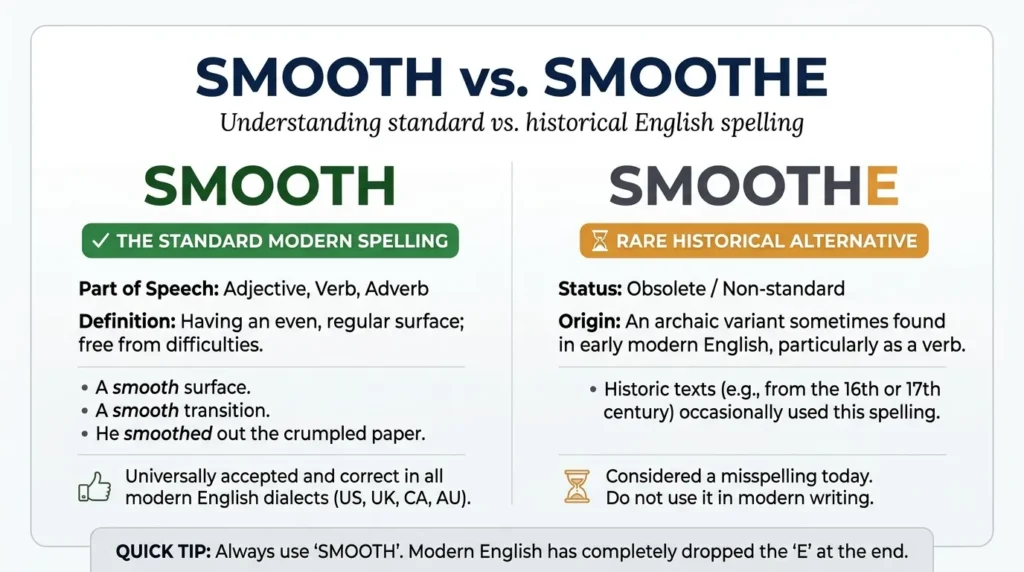

The correct spelling is smooth, not smoothe. Smooth is an adjective meaning even, flat, soft, or free from bumps, roughness, and interruptions. It can also describe something that happens easily or a person who behaves confidently and effortlessly. Smoothe is a common spelling mistake, not a standard alternative spelling of the word. Use smooth in everyday writing, professional communication, and academic work.
What Is the Difference Between Smoothe and Smooth?
The difference between smoothe and smooth is mainly a matter of modern spelling and usage. Smooth is the standard spelling used for both the adjective and the verb. Smoothe has appeared historically as an alternative spelling of the verb, but it is now rare and unsuitable for ordinary modern writing.
Understanding this distinction also helps you avoid confusing the word with related forms such as smooths, smoothed, smoothing, and smoothly.
What Does Smooth Mean?
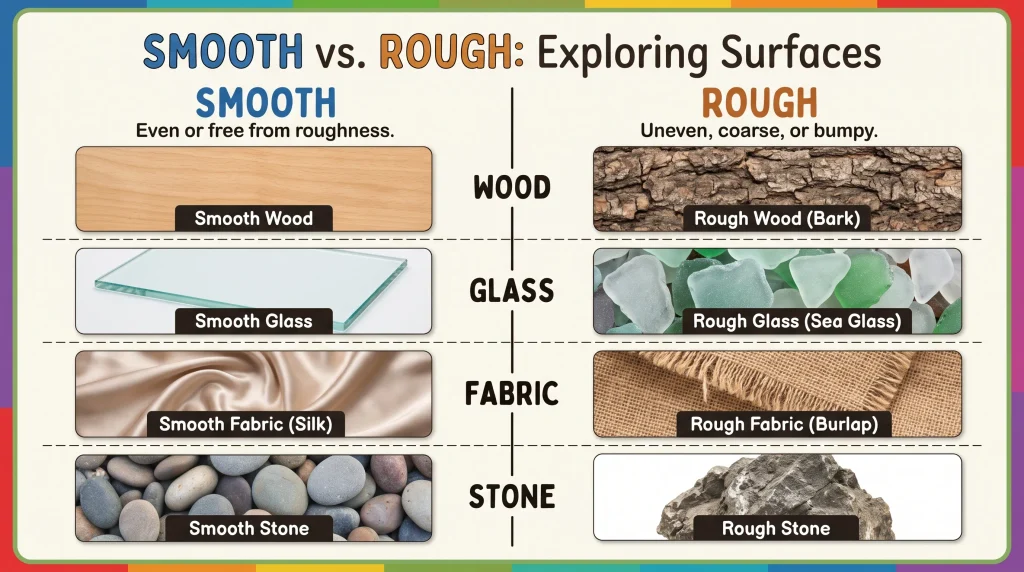
Smooth has several meanings depending on the sentence. It is commonly used as an adjective and a verb.
As an adjective, smooth describes something that has an even surface, feels soft, or does not have rough areas, bumps, or interruptions.
Examples:
- The wooden table has a smooth surface.
- Her hair feels soft and smooth.
- The road was smooth after the repairs.
- The soup has a smooth, creamy texture.
Smooth can also describe an activity or experience that happens without difficulty.
For example:
- We had a smooth journey.
- The application process was smooth.
- Everything went smoothly during the presentation.
As a verb, smooth means to make something even, flat, softer, or less difficult.
Examples:
- She smoothed the wrinkles out of her dress.
- Please smooth the paper before folding it.
- The manager tried to smooth tensions between the departments.
These uses are consistent with the established adjective and verb meanings of smooth. English meaning – Cambridge Dictionary+1
What Does Smoothe Mean?
Smoothe is a historical alternative spelling of the verb smooth. It has appeared in older English writing, but it is not the spelling you should normally use in contemporary English.
For example, an older text might contain:
– The blacksmith tried to smoothe the metal.
In modern writing, use:
– The blacksmith tried to smooth the metal.
There is an important distinction here: calling smoothe simply a word that has never existed would be inaccurate. Historical records and some dictionary references recognize it as an alternative spelling. However, that does not make it the preferred spelling today. Collins English Dictionary+2
Practical advice: Unless you are quoting an old document or reproducing a proper name, choose smooth.
Why Does the Difference Between Smoothe and Smooth Matter?
A spelling mistake can change how professional and reliable your writing appears, even when readers understand what you mean.
Consider these situations:
- Workplace communication: Writing “Please smoothe the transition” in a business report can make the document look poorly edited.
- Academic writing: An incorrect spelling can distract readers from your argument.
- Website content: Repeated spelling mistakes can reduce readers’ confidence in your content.
- Everyday communication: Friends may understand smoothe, but smooth is the spelling they expect to see.
- Professional editing: Consistent spelling makes documents easier to read and maintain.
The problem is not that readers cannot understand smoothe. The problem is that it is an unnecessary departure from the standard spelling.
The Core Rule: Use Smooth, Not Smoothe
SMOOTH
Correct modern spelling
- Smooth surface
- Smooth movement
- Smooth process
- Smooth the fabric
- The presentation went smoothly.
SMOOTHE
Rare historical alternative; avoid in modern writing
- Smoothe surface → Smooth surface
- Smoothe the paper → Smooth the paper
- Smoothe the transition → Smooth the transition
The easiest rule to remember is:
Smooth is the standard spelling whether you use it as an adjective or a verb.
Do not add an extra e to the end of the base word.
How to Use Smooth Correctly
Smooth is flexible because it can perform different grammatical roles. Recognizing its role in a sentence makes it easier to use correctly.
1. Use Smooth as an Adjective
An adjective describes a person, place, thing, or experience.
Use smooth when you want to describe:
- A surface without roughness.
- A texture that feels soft or even.
- A journey without interruptions.
- A process without difficulties.
- A person’s confident or persuasive manner.
Examples:
- The stone has a smooth surface.
- Her skin looks smooth and healthy.
- We enjoyed a smooth flight.
- The company introduced a smooth payment process.
- He gave a smooth and confident presentation.
2. Use Smooth as a Verb
A verb expresses an action. When smooth is a verb, it means to make something even, flat, or easier.
Examples:
- Smooth the dough before placing it in the oven.
- She used her hands to smooth her hair.
- The carpenter smoothed the wooden edges.
- The team changed its schedule to smooth the transition.
- He tried to smooth over the disagreement.
Notice that the spelling remains smooth. You do not change it to smoothe just because it is being used as a verb.
3. Use Smoothed for the Past Tense
When talking about an action that has already happened, use smoothed.
Examples:
- She smoothed the blanket before sitting down.
- The workers smoothed the concrete yesterday.
- He smoothed the paper with his hand.
- The manager smoothed out the scheduling problems.
4. Use Smoothing for an Ongoing Action
Smoothing is the present participle of smooth. It can also function as a noun-like gerund.
Examples:
- She is smoothing the fabric.
- The machine is smoothing the rough surface.
- Smoothing the edges will improve the final result.
5. Use Smoothly When Describing How Something Happens
Smoothly is the adverb form of smooth. An adverb describes a verb, adjective, or another adverb.
Examples:
- The meeting went smoothly.
- The machine operates smoothly.
- The conversation continued smoothly.
- The new system is running smoothly.
Compare:
- Correct: The project went smoothly.
- Less suitable in formal writing: The project went smooth.
The distinction is important because smooth normally describes a noun, while smoothly describes the manner in which an action happens.
Correct Examples of Smooth in Everyday English
Here are 12 original examples showing how smooth works in different situations.
| Situation | Correct example |
|---|---|
| Conversation | Your new haircut looks really smooth. |
| I hope the transition to the new system goes smoothly. | |
| School | The student drew a smooth line across the page. |
| Workplace | We need a smooth process for handling customer requests. |
| Social media | Finally finished my project, and everything went smoothly! |
| Academic writing | The experiment produced a smooth and consistent curve. |
| Cooking | Stir the mixture until it becomes smooth. |
| Travel | Fortunately, our journey was smooth and comfortable. |
| Technology | The updated application runs smoothly on my laptop. |
| Business | Good communication helps ensure a smooth working relationship. |
| Personal care | This cream leaves the skin feeling soft and smooth. |
| Construction | The workers created a smooth finish on the wall. |
Each sentence uses the standard spelling, whether smooth describes a physical surface, an experience, or an action.
Incorrect vs. Correct: Smoothe vs Smooth
The following examples show common mistakes and their correct alternatives.
| ❌ Incorrect | ✅ Correct | Why |
|---|---|---|
| The table has a smoothe surface. | The table has a smooth surface. | Smooth is the standard adjective. |
| Please smoothe the paper. | Please smooth the paper. | The standard verb does not need an extra e. |
| Her skin feels smoothe. | Her skin feels smooth. | Smooth describes the skin’s texture. |
| We had a smoothe journey. | We had a smooth journey. | Smooth describes an uninterrupted journey. |
| He tried to smoothe the situation. | He tried to smooth the situation. | Smooth is the preferred modern verb spelling. |
| The road became smoothe after repairs. | The road became smooth after repairs. | Smooth is the correct modern adjective. |
| She smoothed the fabric to make it smoothe. | She smoothed the fabric to make it smooth. | The past-tense verb is smoothed; the adjective is smooth. |
| The meeting went smoothe. | The meeting went smoothly. | Smoothly is the conventional adverb. |
| We need to smoothe out the problems. | We need to smooth out the problems. | The phrasal verb is smooth out. |
| He applied cream to keep his hands smoothe. | He applied cream to keep his hands smooth. | The adjective takes no final e. |
A Useful Grammar Observation
Not every sentence containing the word smooth needs to use smoothly.
For example:
- The road is smooth. (Adjective)
- The car moves smoothly. (Adverb)
- She smooths the fabric. (Verb)
- She smoothed the fabric. (Past-tense verb)
The correct form depends on the grammatical job the word performs, not simply on whether the sentence describes something pleasant or effortless.
Why Do People Confuse Smoothe and Smooth?
Although the spelling difference is only one letter, several language habits contribute to this mistake.
1. Phonetic Similarity
Both spellings are pronounced the same way in ordinary English: /smuːð/.
The final e in smoothe does not create a different pronunciation. Consequently, someone who hears the word cannot identify its spelling from pronunciation alone.
This is a common reason English learners make spelling mistakes: spoken language does not always reveal the correct written form.
2. Similarity to Other English Words
English contains many words ending in -the or -e.
For example:
- Soothe
- Breathe
- Teethe
- Wreathe
Because these words have similar visual or sound patterns, writers may incorrectly assume that smoothe follows the same spelling pattern.
However, English spelling does not work through one universal pattern. Individual words have established spellings that must be learned.
3. Confusion With the Past-Tense Form
The word smoothed contains an additional letter compared with smooth.
Some writers may mistakenly believe that the base form should also contain an extra letter or follow a similar spelling pattern.
Remember:
- Base form: smooth
- Third-person singular: smooths
- Past tense: smoothed
- Present participle: smoothing
4. Overgeneralisation
Overgeneralisation happens when someone applies a spelling rule from one word to another word where it does not belong.
For example, a learner who knows the spelling of soothe may assume that smooth should also be written as smoothe.
The spelling looks logical, but standard usage does not support that assumption.
5. Autocorrect and Spellcheck Limitations
Spellcheck tools are helpful, but they are not perfect.
Some may recognize unusual historical forms, proper names, or specialized terms. Others may miss errors when the incorrect spelling appears in a context that the software cannot properly interpret.
A spellchecker can also fail to detect a correctly spelled but incorrectly used word.
For example, smooth and smoothly are both valid words, but they are not interchangeable in every sentence.
Always review the meaning and grammar of the complete sentence instead of relying entirely on automatic correction.
6. Translation Interference
English learners sometimes translate a word directly from their first language.
If the translated word has a different spelling pattern or grammatical structure, they may transfer that pattern into English.
The solution is to learn smooth as a complete English word, including its adjective, verb, and related forms.
Common Mistakes Checklist
Use this checklist when proofreading your writing.
- Adding an unnecessary e: Writing smoothe instead of smooth. Remember that smooth is the standard base form.
- Using smoothe as an adjective: Writing “a smoothe surface.” Use smooth because it is the established adjective spelling.
- Using smoothe as a verb: Writing “Please smoothe the fabric.” Use smooth.
- Confusing smooth with smoothed: Smooth is the base form; smoothed is the past tense and past participle.
- Confusing smooth with smoothly: Smooth usually describes a noun, while smoothly describes how an action happens.
- Using smooth as an adverb in formal writing: Writing “The meeting went smooth.” Prefer “The meeting went smoothly.”
- Assuming pronunciation determines spelling: Both spellings sound alike, so learn the written form rather than relying on sound.
- Trusting autocorrect without checking context: A tool may not identify every grammatical or spelling problem. Read the sentence again.
Smoothe vs Smooth in Real English
Knowing whether a spelling is historically recorded is different from knowing whether it is suitable for modern communication. These three categories help explain the distinction.
1. Grammatically Correct: Smooth
Smooth is the standard spelling in contemporary English. It works as an adjective and a verb, so you can use it to describe a surface or explain an action. For example, “The floor is smooth” and “Please smooth the surface” are both correct. This is the spelling expected in everyday conversation, business documents, educational writing, and professional publications.
2. Grammatically Possible but Unnatural or Outdated: Smoothe
Smoothe has historical support as an alternative spelling of the verb smooth. However, it is rare in contemporary writing and is not the normal spelling readers expect. A historical quotation may preserve it accurately, but using it in an ordinary email or article is unnecessary. Its existence in older texts should not be mistaken for evidence that it is an equally accepted modern alternative.
3. Natural Everyday English: Smooth and Its Related Forms
Modern speakers and writers normally use smooth, smooths, smoothed, smoothing, and smoothly. For instance, someone might say, “The process was smooth,” or write, “The process went smoothly.” Both are natural, although they use different grammatical structures. The extra e in smoothe does not provide a different everyday meaning or pronunciation.
American vs. British English: Is There a Difference?
There is no meaningful American-versus-British spelling difference between smooth and smoothe.
Both varieties use smooth as the standard modern spelling.
| Feature | American English | British English |
|---|---|---|
| Standard spelling | Smooth | Smooth |
| Adjective | Smooth | Smooth |
| Verb | Smooth | Smooth |
| Past tense | Smoothed | Smoothed |
| Present participle | Smoothing | Smoothing |
| Adverb | Smoothly | Smoothly |
| Smoothe | Avoid in ordinary writing | Avoid in ordinary writing |
For example:
- American English: The road has a smooth surface.
- British English: The road has a smooth surface.
The spelling remains unchanged. You do not need to choose between two regional forms.
Formal vs. Informal Usage
Smooth is appropriate in both formal and informal English.
Formal English:
- The updated procedure should ensure a smooth transition.
- The equipment operates smoothly under normal conditions.
- The research team smoothed the data to reveal the overall trend.
Informal English:
- That was a smooth move!
- Everything went smoothly today.
- This fabric feels really smooth.
Smoothe, on the other hand, is not recommended in either register of modern English. It may appear in historical quotations or deliberately chosen names, but it is not a useful alternative for everyday communication.
ALSO CHECKOUT: Fair vs. Fare: What’s the Difference?
Comparison Table: Smooth, Smoothe, Smoothed, and Smoothly
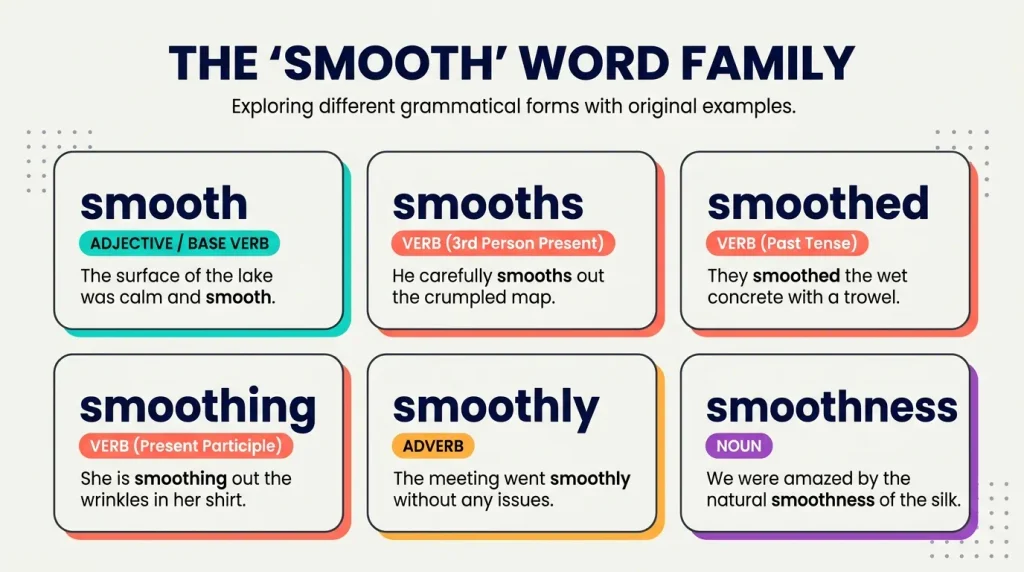
These related forms are easy to confuse because they share the same root.
| Word | Part of speech | Meaning or function | Example |
|---|---|---|---|
| Smooth | Adjective | Even or free from roughness | The surface is smooth. |
| Smooth | Verb | To make something even | Smooth the edges. |
| Smoothe | Historical alternative verb spelling | Older form of smooth | Found in historical writing. |
| Smooths | Verb | Present tense with a singular subject | She smooths her hair. |
| Smoothed | Verb | Past tense or past participle | He smoothed the paper. |
| Smoothing | Verb/gerund | Ongoing action or activity | She is smoothing the fabric. |
| Smoothly | Adverb | In an even or effortless manner | The system works smoothly. |
| Smoothness | Noun | The quality of being smooth | I like the smoothness of the material. |
Important: Smoothe and smooths are not interchangeable. Smooths is a standard inflected form of the verb smooth, while smoothe is a rare historical alternative spelling of the base verb.
ALSO READ: Smoothe vs Smooth: Meaning, Spelling, and Correct Usage
Real-Life Situations: How to Choose the Correct Word
The following scenarios show how to apply the spelling rule in practical communication.
1. During a Job Interview
You are describing how you handled a difficult project.
Incorrect: “I helped smoothe the transition between departments.”
Correct: “I helped smooth the transition between departments.”
Why: Smooth is the standard verb used to describe making a process easier.
2. In a Business Email
You are writing to a colleague about a new company system.
Incorrect: “We hope the new system provides a smoothe experience.”
Correct: “We hope the new system provides a smooth experience.”
Why: Smooth describes the quality of the experience.
3. In a School Assignment
You are describing a piece of wood in a science or design project.
Incorrect: “The material has a smoothe surface.”
Correct: “The material has a smooth surface.”
Why: Smooth is the correct adjective for describing an even surface.
4. During a Workplace Meeting
You want to discuss a disagreement between two teams.
Incorrect: “We should smoothe out these differences.”
Correct: “We should smooth out these differences.”
Why: Smooth out is a standard phrasal verb meaning to resolve or reduce difficulties.
5. In a Text Message
You want to tell a friend that their presentation went well.
Incorrect: “Your presentation went smoothe!”
Correct: “Your presentation went smoothly!”
Why: Smoothly is the conventional adverb describing how the presentation went.
6. In Academic Writing
You are describing a graph or statistical result.
Incorrect: “The graph displays a smoothe curve.”
Correct: “The graph displays a smooth curve.”
Why: Smooth describes the even appearance of the curve.
How to Remember Smoothe vs Smooth
You do not need to memorize a complicated grammar rule to remember the difference.
Use this simple memory trick:
Smooth has no extra E. Keep it short and keep it correct.
Remember these three examples:
- A smooth surface.
- Smooth the paper.
- The process went smoothly.
All three use the standard spelling or its correct grammatical form.
Another useful technique is to remember the word smoothly. If you can spell smoothly correctly, you can identify the base word smooth without adding an unnecessary e.
Test Your Knowledge: Smoothe vs Smooth Quiz
Choose the correct answer for each sentence.
Quick spelling and grammar test
0/6 answered
1. The wooden floor feels very ____.smoothesmoothsmoothly
2. Please ____ the wrinkles out of your shirt.smoothesmoothsmoothly
3. The meeting went ____.smoothsmoothesmoothly
4. She ____ her hair before leaving.smoothssmoothesmoothly
5. The workers ____ the concrete yesterday.smoothingsmoothedsmoothly
6. We want to ensure a ____ transition.smoothlysmoothesmooth
Check my answers
Quick Summary
The correct modern spelling is smooth, not smoothe. Smooth works as both an adjective and a verb. As an adjective, it describes something even, soft, or free from difficulty. As a verb, it means to make something flat, even, or easier. Smoothe has appeared historically as an alternative spelling of the verb, but it is rare and should be avoided in contemporary writing. Use smoothed for the past tense, smoothing for an ongoing action, smooths for the third-person singular, and smoothly when you need an adverb. There is no significant American or British spelling difference. When in doubt, choose smooth.
Frequently Asked Questions (FAQ)
1. Is smoothe a real English word?
Smoothe has historical use as an alternative spelling of the verb smooth. However, it is rare in contemporary English. Smooth is the standard spelling and the better choice for modern communication.
2. Is smooth or smoothe correct?
Smooth is correct for standard modern English. Use it whether you are describing a surface or talking about making something even. Smoothe is an outdated or uncommon alternative spelling.
3. Does smoothe have a different meaning from smooth?
No meaningful difference in everyday meaning exists. Historically, smoothe has been used as an alternative spelling of the verb smooth. It does not describe a separate action or quality.
4. Is smooth an adjective or a verb?
Smooth can be both. As an adjective, it describes something even or free from roughness. As a verb, it means to make something even or less difficult.
Examples:
- Adjective: The glass feels smooth.
- Verb: Smooth the paper with your hand.
5. What is the past tense of smooth?
The past tense of smooth is smoothed.
Example: “She smoothed the wrinkles from her dress before the interview.”
The spelling does not change to smoothed or smoothe.
6. Is it smooth or smoothly?
Both are correct, but they have different grammatical functions. Smooth is usually an adjective, while smoothly is an adverb.
- Correct: The machine is smooth.
- Correct: The machine operates smoothly.
Choose the form that fits the sentence.
7. Is it smooths or smoothe?
Smooths is the standard third-person singular present form of the verb smooth.
Example: “She smooths her hair before going outside.”
Smoothe is a rare historical alternative spelling of the base verb, not the standard form you should use.
8. Is smooth the same in American and British English?
Yes. Both American and British English use smooth as the standard spelling. There is no regional spelling change that requires you to write smoothe.
9. Can I use smoothe in formal writing?
It is best to avoid smoothe in modern formal writing. Use smooth instead. The historical spelling may be preserved when quoting an older source, but it is not appropriate as a normal alternative in professional documents.
10. Why do people spell smooth as smoothe?
The mistake may come from words such as soothe and breathe, which have similar spelling patterns. Because both forms are pronounced alike, writers may also assume that the extra e does not matter.
11. What is the adverb form of smooth?
The adverb form is smoothly.
Example: “The new software runs smoothly.”
It describes how an action takes place, rather than describing the software itself.
12. What is an easy trick to remember smooth vs smoothe?
Remember this sentence: “A smooth surface needs no extra E.” The standard spelling is smooth. When you need the adverb, simply add -ly to form smoothly.


