Have you ever wondered whether to write fair or fare? These two words sound exactly alike, but they have different meanings and grammatical uses. Choosing the wrong spelling can change the meaning of your sentence.
The easiest way to remember the difference is to associate fair with fairness, equal treatment, and public events, while fare relates to transportation costs, food, and how someone performs or manages in a situation.
Let’s explore their meanings, grammatical roles, common expressions, and everyday uses so you can choose the correct word confidently.
Fair vs. Fare
Fair means just, reasonable, unbiased, or acceptable. It can also refer to a public event featuring exhibitions, entertainment, or stalls. Fare means the money paid for transportation, a type of food, or a person’s experience or performance when used as a verb. For example, you pay a bus fare, visit a county fair, and hope to fare well in an interview.
What Is the Difference Between Fair and Fare?
Fair and fare are homophones. Homophones are words that have the same pronunciation but different spellings and meanings.
Both words are pronounced /fer/ in standard American English and /feə/ in many British English accents. Their pronunciation alone cannot tell you which spelling to use. You must understand what the sentence means.
What Does Fair Mean?
Fair has several meanings, depending on the context. It is commonly used as an adjective, noun, and adverb.
As an adjective, it can describe something that is just, reasonable, impartial, or light in color. It can also describe acceptable quality or pleasant weather.
Examples:
- The teacher gave every student a fair chance.
- We received a fair price for the furniture.
- She has fair skin and light hair.
- The weather looks fair enough for a picnic.
- His performance was fair, but it could have been better.
As a noun, fair commonly refers to an organized public event where people display or sell products, enjoy entertainment, or participate in activities.
Examples:
- We visited the county fair last weekend.
- The school organized a science fair.
- Several companies attended the career fair.
As an adverb, fair appears in expressions such as play fair, meaning to behave honestly and follow the rules.
Example:
– Everyone should play fair during the competition.
What Does Fare Mean?
Fare is commonly used as a noun and a verb.
As a noun, it has three particularly useful meanings:
- Transportation cost: The money paid for traveling by bus, train, taxi, or airplane.
- Food: A particular type or range of food served or available.
- Paying passenger: A person transported by a taxi or another hired vehicle.
Examples:
- The bus fare has increased this month.
- The restaurant serves traditional Italian fare.
- The taxi driver picked up another fare.
As a verb, fare means to get along, manage, perform, or experience a particular outcome.
Examples:
- How did you fare in your final examination?
- The company fared well during the economic downturn.
- Small businesses may fare poorly during a recession.
The verb is especially useful when discussing how someone or something performs under particular circumstances.
Why Does the Difference Between Fair and Fare Matter?
Using the correct word helps readers understand your intended meaning without confusion.
Although both spellings are legitimate English words, they are not interchangeable. A spelling mistake can make an otherwise clear sentence inaccurate.
Consider these situations:
- Travel: Writing bus fair instead of bus fare incorrectly identifies the transportation cost.
- Education: Writing science fare instead of science fair gives the event an incorrect name.
- Workplace communication: Writing How did you fair in the interview? uses the wrong verb.
- Food writing: Writing traditional fair instead of traditional fare changes the meaning of the description.
- Everyday conversation: Writing That’s not fare instead of That’s not fair can make a simple message look careless.
There is another reason to understand this distinction: spellcheckers may not identify the problem. Both fair and fare are correctly spelled English words, so automated tools may accept either one even when the meaning is wrong.
The Core Rule: When to Use Fair and Fare
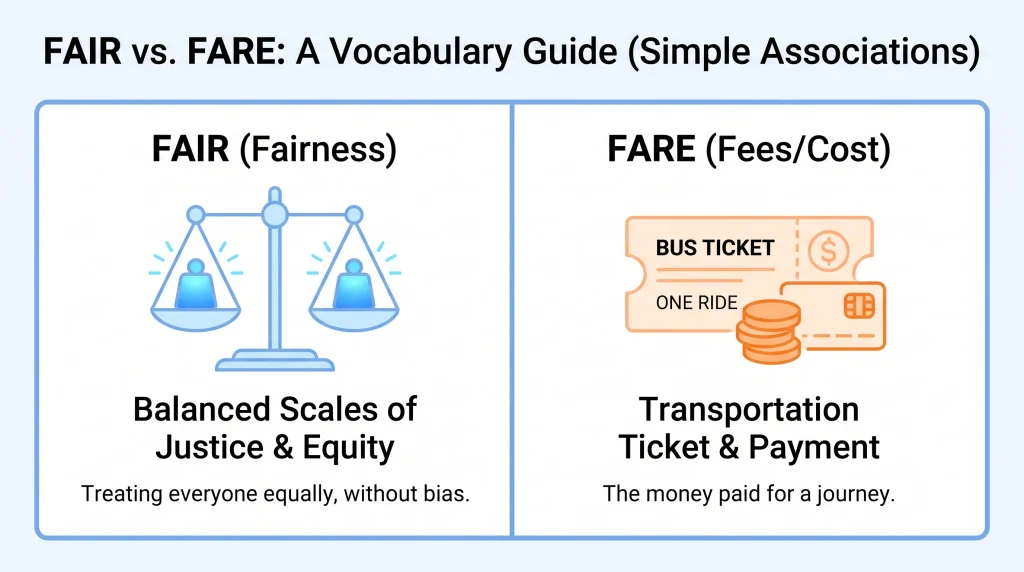
Use FAIR
When discussing:
- Justice or equal treatment
- Reasonable prices or decisions
- Light-colored hair or skin
- Acceptable quality or pleasant weather
- Public events and exhibitions
- Playing honestly
Use FARE
When discussing:
- Bus, train, taxi, or airplane costs
- Food or a particular type of cuisine
- A paying passenger
- How someone performs or manages
- How a situation turns out
The simplest rule: If you mean justice, reasonable treatment, or an event, use fair. If you mean a travel fee, food, or how someone gets along, use fare.
How to Use Fair and Fare Correctly
Understanding their grammatical roles makes the distinction easier because each word appears in different common sentence patterns.
When to Use Fair
Use fair in the following situations.
1. To describe justice and equal treatment
Use fair when people receive reasonable or unbiased treatment.
Examples:
- Every employee deserves fair treatment.
- The judge made a fair decision.
- Both teams received a fair opportunity to compete.
2. To describe reasonable prices or conditions
Fair can describe something that is reasonable or acceptable.
Examples:
- The mechanic offered a fair price.
- We negotiated a fair agreement.
- The company provides fair working conditions.
3. To describe light-colored hair or skin
In descriptions of appearance, fair can mean light-colored or pale.
Examples:
- She has fair hair and blue eyes.
- People with fair skin may burn easily in strong sunlight.
4. To describe a public event
Use fair when referring to an organized gathering or exhibition.
Examples:
- The annual book fair attracts thousands of visitors.
- My university is hosting a job fair.
- Children enjoyed the rides at the summer fair.
5. To describe acceptable quality or pleasant weather
Depending on the context, fair can mean moderately good, acceptable, or clear and pleasant.
Examples:
- Her examination result was fair.
- We enjoyed a few days of fair weather.
When to Use Fare
Use fare in these common situations.
1. To describe transportation costs
Use fare for the amount charged for a journey.
Examples:
- The train fare is cheaper than the taxi fare.
- I paid my bus fare in cash.
- Airline fares usually vary according to demand.
2. To describe food
Use fare when describing a particular style, category, or selection of food.
Examples:
- The restaurant specializes in seafood fare.
- Traditional Pakistani fare was served at the event.
- The hotel offers excellent vegetarian fare.
This use is more descriptive than simply saying food or meals.
3. To describe a passenger
In transportation contexts, fare can also mean a paying passenger.
Example:
– The taxi driver waited for another fare outside the station.
4. To describe performance or progress
Use fare as a verb when discussing how someone manages or performs.
Examples:
- How did you fare in the job interview?
- The students fared well in their examinations.
- The business did not fare well during its first year.
Common Expressions With Fair and Fare
Learning common word combinations makes correct usage easier.
| Expression | Meaning | Example |
|---|---|---|
| Fair play | Honest and acceptable behavior | We believe in fair play. |
| Fair enough | Reasonable or acceptable | Fair enough; I understand. |
| Fair chance | An equal opportunity | Everyone deserves a fair chance. |
| Fair weather | Clear or pleasant weather | We enjoyed fair weather. |
| Bus fare | Cost of a bus journey | The bus fare is affordable. |
| Airfare | Cost of air travel | Our airfare was expensive. |
| Fare well | To manage or perform successfully | I hope you fare well. |
| Traditional fare | Traditional food | The café serves traditional fare. |
| Farewell | A goodbye or parting expression | We attended her farewell party. |
| How did you fare? | How did you manage or perform? | How did you fare in the test? |
Notice the difference between fare well and farewell. The first is a verb followed by an adverb. The second is a single word used for saying goodbye or describing a departure.
Correct Examples of Fair and Fare in Sentences
Here are 15 original examples showing how both words work in different situations.
Everyday Conversation
- Fair: I think splitting the restaurant bill equally is fair.
- Fare: How did you fare during your first week at university?
- Fair: That’s not fair; you received more time than everyone else.
Emails and Workplace Communication
- Fair: We appreciate your fair assessment of the proposal.
- Fare: I hope the new department will fare well under your leadership.
- Fair: The manager offered a fair salary based on the employee’s experience.
School and Education
- Fair: Our school is organizing a book fair next Friday.
- Fare: Most students fared well in the mathematics examination.
- Fair: Every participant should receive a fair opportunity to present their project.
Social Media and Informal Writing
- Fair: Is it fair to charge extra for basic services?
- Fare: How do you think our national team will fare this season?
- Fair: We had a wonderful day at the local food fair.
Academic and Professional Writing
- Fair: The researchers used a fair selection process to reduce bias.
- Fare: The organization fared better than expected despite financial difficulties.
- Fare: The report examines how traditional regional fare influences local tourism.
Incorrect vs. Correct: Fair or Fare?
The following table highlights common spelling mistakes, their corrections, and the reasons behind them.
| ❌ Incorrect | ✅ Correct | Why |
|---|---|---|
| The bus fair is expensive. | The bus fare is expensive. | Fare means the cost of transportation. |
| That’s not fare. | That’s not fair. | Fair describes just or reasonable treatment. |
| How did you fair in the exam? | How did you fare in the exam? | Fare is the verb meaning to perform or manage. |
| We visited the county fare. | We visited the county fair. | Fair refers to a public event. |
| The restaurant serves traditional fair. | The restaurant serves traditional fare. | Fare can describe a type of food. |
| She has fare hair. | She has fair hair. | Fair describes light-colored hair. |
| Everyone deserves fare treatment. | Everyone deserves fair treatment. | Fair means impartial or just. |
| The airline increased its fair. | The airline increased its fare. | Fare refers to the transportation charge. |
| I hope you fair well. | I hope you fare well. | Fare is the correct verb in this expression. |
| We enjoyed fare weather. | We enjoyed fair weather. | Fair can describe clear or pleasant weather. |
| The school held a science fare. | The school held a science fair. | Fair is an organized exhibition or event. |
| The taxi driver waited for another fair. | The taxi driver waited for another fare. | Fare can mean a paying passenger. |
Why Do People Confuse Fair and Fare?
Several features of English make these words easy to mix up.
1. They Sound Exactly the Same
The main reason is pronunciation. Fair and fare are homophones, so listeners cannot distinguish their spelling simply by hearing them.
For example, when someone says:
“The bus fare is too expensive.”
You cannot identify the spelling from the sound alone. You need to understand the sentence.
2. Their Spellings Look Similar
Both words have four letters and share three of them. The only difference is the vowel combination in the middle.
This small spelling difference makes typing mistakes more likely, particularly when writing quickly.
3. People Overgeneralize Familiar Rules
Many learners remember that fair means reasonable or good and begin using it whenever they want to describe a positive result.
However, English uses fare as a verb when discussing how someone performs or manages.
For example:
- Incorrect: The team faired badly.
- Correct: The team fared badly.
Knowing one meaning of a word does not mean it works in every grammatical situation.
4. Autocorrect and Spellcheck Cannot Always Help
Most spelling tools recognize both words as valid English vocabulary.
If you type The bus fair is expensive, your software may not identify the error because fair is correctly spelled. The problem is its meaning, not its spelling.
Always proofread the sentence for context.
5. Translation Can Create Confusion
Some languages use a single word or similar expressions for concepts such as reasonable treatment, transportation charges, and performance.
When learners translate directly into English, they may select the wrong homophone.
The solution is to learn each word through common English expressions rather than translating individual words without context.
Common Mistakes Checklist
Use this checklist when proofreading your writing.
- Writing bus fair: Transportation charges are called fares. Remember bus fare and train fare.
- Writing county fare: Public exhibitions and entertainment events are fairs. Remember county fair and book fair.
- Writing fair well: When you mean to perform or manage successfully, use fare well.
- Writing that’s not fare: When discussing justice or reasonable treatment, use fair.
- Writing traditional fair: When describing a type of food, use fare.
- Writing fare skin: When describing light-colored skin, use fair.
- Confusing farewell with fare well: Farewell is one word for a goodbye, while fare well is a verb phrase.
- Trusting autocorrect completely: Check the meaning yourself because both spellings are valid words.
ALSO CHECKOUT: See vs Sea: Meaning, Difference & Examples
Fair vs. Fare in Real English
Understanding dictionary definitions is useful, but knowing how people actually use these words makes your writing more natural.
Grammatically Correct: Fair
“Your decision was fair.”
This is grammatically correct and natural everyday English. It communicates that a decision was reasonable or impartial. You can use fair in conversations, emails, workplace discussions, and academic writing whenever you want to describe equal treatment or a reasonable outcome.
Grammatically Correct: Fare
“The students fared well in their examinations.”
This sentence is grammatically correct. Fared is the past tense of fare, and well describes how the students performed. The expression is natural, particularly in reports, formal discussions, and conversations about results or performance.
Grammatically Possible but Unnatural: Fare
“I will fare the bus tomorrow.”
This is not a natural way to express paying for transportation. Although fare has historical and specialized verb uses, modern everyday English does not normally use it this way. Say “I will pay the bus fare tomorrow” or “I will take the bus tomorrow,” depending on your intended meaning.
Natural Everyday English: Fair
“That’s fair enough.”
This is a common conversational expression. People use it to show that they accept an explanation, decision, or suggestion as reasonable. It does not necessarily mean they completely agree; it simply communicates that something is acceptable. For example, “We can meet at six instead. Fair enough?”
Natural Everyday English: Fare
“How did you fare?”
This is a correct and established expression, especially when asking about someone’s experience or performance. However, in casual conversation, people often say “How did it go?” or “How did you do?” instead. Fare can sound slightly more formal or deliberate, depending on the situation.
ALSO READ: In the Street vs On the Street: What’s the Difference?
American vs. British English: Is There a Difference?
There is no major difference between American and British English in the basic meanings or spelling of fair and fare.
Both varieties use:
- Fair: Just, reasonable, impartial, or a public event.
- Fare: Transportation cost, food, or performance.
Both also use expressions such as bus fare, fair treatment, fair play, and fare well.
The main differences you may notice are related to accent and vocabulary preferences rather than the spelling rule.
For example, Americans commonly say airfare, while British English also uses air fare. Both forms are understood internationally.
You do not need to learn separate American and British rules for choosing between these two words.
Formal vs. Informal Usage
Both words work in formal and informal English. However, their individual meanings and expressions can sound different depending on the situation.
Fair in Formal and Informal English
In formal writing, fair is commonly used to describe impartial decisions, equal opportunities, and reasonable treatment.
Example:
“The organization introduced a fair recruitment policy.”
In informal conversation, it appears in expressions such as:
“That’s fair enough.”
Both uses are natural and appropriate for their respective contexts.
Fare in Formal and Informal English
In formal writing, fare is often used when describing performance, outcomes, transportation costs, and food.
Example:
“The company fared better than expected during the financial year.”
In everyday conversation, fare also appears in questions such as:
“How did you fare in the interview?”
However, many speakers prefer “How did it go?” in casual situations.
The food meaning of fare is also more descriptive or editorial than the everyday word food.
Comparison Table: Fair vs. Fare
| Feature | Fair | Fare |
|---|---|---|
| Pronunciation | /fer/ (American) | /fer/ (American) |
| Main meaning | Just or reasonable | Transportation cost |
| Part of speech | Adjective, noun, adverb | Noun, verb |
| As an adjective | Fair treatment | Not normally used as an adjective |
| As a noun | Public event | Travel charge, food, passenger |
| As a verb | Rare specialized uses | To manage or perform |
| Common phrase | Fair play | Bus fare |
| Other expression | Fair enough | Fare well |
| Food meaning | No, not in this sense | Yes |
| Transportation meaning | No | Yes |
| Example | Everyone deserves a fair chance. | The train fare is affordable. |
Real-Life Situations: Fair or Fare?
Here are five everyday situations that demonstrate which word belongs in each context.
1. During a Job Interview
A hiring manager asks a candidate about a previous interview.
Correct:
“How did you fare in your last interview?”
Why: Fare means to perform or manage in a particular situation.
2. While Traveling
A passenger asks a bus conductor about the ticket price.
Correct:
“How much is the bus fare?”
Why: Fare refers to the amount paid for transportation.
3. During a Workplace Meeting
An employee discusses a new company policy.
Correct:
“I believe this policy is fair to all employees.”
Why: Fair describes reasonable and impartial treatment.
4. While Sending a Text Message
A friend complains that another person received a better opportunity.
Correct:
“That’s not fair. Everyone should get the same chance.”
Why: Fair communicates the idea of justice and equal treatment.
5. At a School Event
A parent tells a friend about an upcoming exhibition.
Correct:
“My daughter’s school is organizing a science fair this weekend.”
Why: Fair refers to an organized public or educational event.
How to Remember Fair vs. Fare Easily
If you struggle to remember the difference, use these simple associations.
- Fair = Fairness: Both words begin with the letter F and connect to the idea of just treatment.
- Fare = Fee: Think of a transportation fee. A bus fare is the money you pay for a journey.
- Fare = Food: Remember that restaurants can serve traditional fare.
- Fare = Performance: When asking how someone performed, ask, “How did you fare?”
- Fair = Event: A book fair, job fair, or county fair is an organized event.
The most useful memory trick is to associate fare with a fee and fair with fairness. These two connections cover many common situations.
Practice Quiz: Choose Fair or Fare
Test your understanding with these 10 questions. Choose the correct word for each sentence.
Fair vs. Fare Quiz
0/10 answered
1. The taxi ___ from the airport was expensive.FairFare
2. Everyone deserves a ___ opportunity.FairFare
3. How did you ___ in your examination?FairFare
4. We visited the annual book ___.FairFare
5. The restaurant serves traditional Italian ___.FairFare
6. She has beautiful ___ hair.FairFare
7. The company did not ___ well during the crisis.FairFare
8. Is this a ___ price for the service?FairFare
9. The airline reduced its ticket ___.FairFare
10. Children enjoyed the rides at the county ___.FairFare
Check my answers
Quick Summary: Fair vs. Fare
Fair and fare are homophones, meaning they sound alike but have different meanings and spellings. Use fair when describing justice, reasonable treatment, light-colored hair or skin, acceptable conditions, or public events such as book fairs and county fairs. Use fare when referring to transportation costs, particular types of food, paying passengers, or someone’s performance. For example, you pay a bus fare, expect fair treatment, and ask how someone fared in an interview. Remember the simple connection: fair relates to fairness, while fare relates to fees and performance. Always consider the meaning of your sentence before choosing either spelling.
FAQ: Fair vs. Fare
1. Are fair and fare pronounced the same?
Yes. Fair and fare are homophones. They have the same pronunciation in standard American English and in many British English accents, but their spellings and meanings are different.
2. Is it fair well or fare well?
The correct expression is fare well when you mean to do well, manage successfully, or experience a positive outcome.
Example: “I hope you fare well in your new position.”
3. Is it farewell or fairwell?
Farewell is the correct spelling. It is a word used to say goodbye or describe a departure. Fairwell is not the standard spelling.
Example: “We organized a farewell dinner for our colleague.”
4. Is it bus fair or bus fare?
The correct expression is bus fare because fare means the money paid for transportation.
Example: “The bus fare from my home to the city center is affordable.”
5. Can fare be used to describe food?
Yes. Fare is a noun that can describe a particular type or range of food.
Examples include traditional fare, Italian fare, seafood fare, and vegetarian fare.
6. Can fair be used as a noun?
Yes. Fair commonly refers to an organized public event where people display or sell products, participate in activities, or enjoy entertainment.
Examples include a book fair, science fair, job fair, and county fair.
7. Is fair an adjective or an adverb?
Fair is commonly an adjective and can also function as an adverb in expressions such as play fair. As an adjective, it can mean just, reasonable, light-colored, or acceptable.
8. Is fare a noun or a verb?
Fare can be both. As a noun, it means a transportation charge, a paying passenger, or a type of food. As a verb, it means to manage, perform, or experience a particular outcome.
9. How did you fare or how did you fair?
The correct expression is How did you fare? It asks about someone’s experience or performance.
Example: “How did you fare in your driving test?”
10. Is there a difference between fair and fare in American and British English?
No major difference exists in their core meanings or spelling. Both varieties use fair for justice and public events and fare for transportation costs, food, and performance.
11. Why doesn’t spellcheck correct fair and fare mistakes?
Both words are correctly spelled English words. Spellcheckers may recognize the spelling without understanding whether the word fits the sentence. Contextual proofreading is necessary to identify these errors.
12. What is the easiest way to remember fair vs. fare?
Remember two associations: fair = fairness and fare = fee. Use fair for reasonable treatment and events, and fare for transportation charges, food, and performance.