


The correct phrase is “has run,” not “has ran.” The verb run is irregular, so its past simple form is ran, while its past participle is run. After has, have, or had, you must use the past participle. For example, “She has run five miles” is correct, while “She has ran five miles” is grammatically incorrect in standard English.
What Is the Difference Between Has Run and Has Ran?
The difference comes down to the grammatical form of the verb run. English verbs can have different forms depending on how they function in a sentence. With regular verbs, the past tense and past participle often look the same. However, run is an irregular verb, so its forms are different.
Here are the three principal forms:
| Verb form | Word | Example |
|---|---|---|
| Base form | Run | I run every morning. |
| Simple past | Ran | I ran yesterday. |
| Past participle | Run | I have run today. |
A past participle is a verb form used with helping verbs such as has, have, and had to build perfect tenses. Since run is the past participle of run, the correct expression is has run.
What Does Has Run Mean?
Has run is the present perfect form of the verb run. It describes an action that happened before now and has a connection to the present.
Depending on the context, it can describe physical movement, operating equipment, managing an organization, or participating in an event.
Examples:
- She has run three marathons.
- The engine has run smoothly all morning.
- He has run his own business for eight years.
- The software has run without any errors.
What Does Has Ran Mean?
Has ran is a nonstandard verb combination that does not follow the rules of standard English grammar.
The problem is not the word ran itself. Ran is a perfectly correct word when used as the simple past form.
For example:
- Correct: He ran to the station.
- Incorrect: He has ran to the station.
- Correct: He has run to the station.
The mistake happens when someone uses the simple past form ran where the past participle run is required.
Why Does the Difference Matter?
Choosing the correct verb form helps readers understand your sentences without being distracted by grammatical errors.
This distinction matters in several everyday situations:
- Professional emails: Correct grammar helps your communication appear polished and reliable.
- Academic writing: Using the correct past participle demonstrates control of English verb forms.
- Job applications: Grammar mistakes can distract employers from your qualifications.
- Business reports: Accurate verb forms make written updates clearer and more professional.
- Everyday conversations: Understanding the difference helps you speak more confidently.
The issue is particularly important because run has several meanings. You might use it to describe exercise, operating a machine, managing a company, or organizing an event. The grammatical rule remains the same in every case.
The Core Rule: Use Has Run, Not Has Ran
Has + Past Participle = Correct
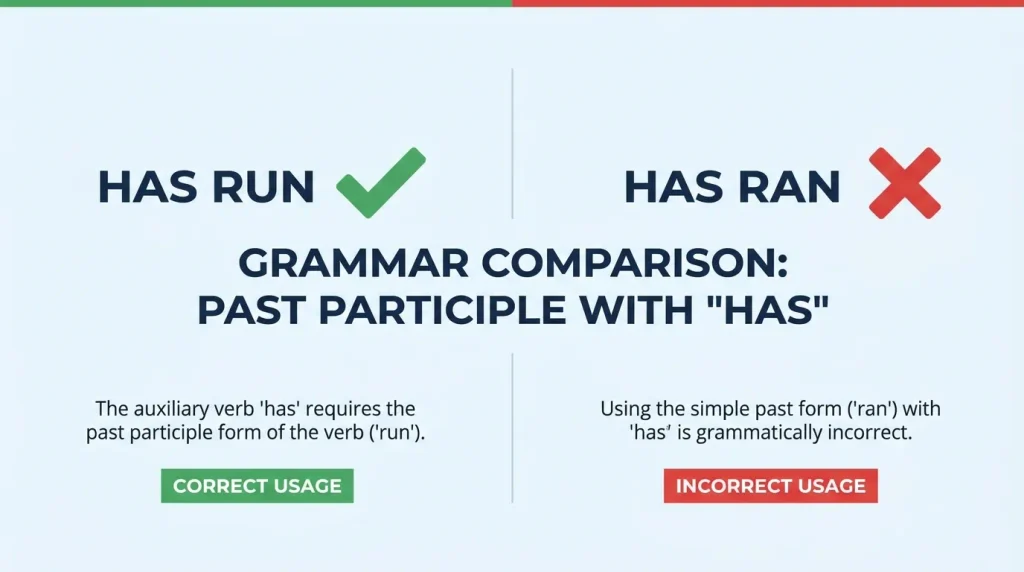
The correct verb pattern:
- Has run
- Have run
- Had run
The incorrect standard-English pattern:
- Has ran
- Have ran
- Had ran
Remember: The past participle of run is run, not ran.
The rule is straightforward: whenever you use has, have, or had as an auxiliary verb in a perfect construction, use the past participle of the main verb.
This is why you write:
- She has run five miles.
- They have run five miles.
- She had run five miles before breakfast.
You do not write:
- She has ran five miles.
- They have ran five miles.
- She had ran five miles before breakfast.
The same principle applies to other irregular verbs:
| Base form | Simple past | Past participle |
|---|---|---|
| Go | Went | Gone |
| Eat | Ate | Eaten |
| Write | Wrote | Written |
| See | Saw | Seen |
| Begin | Began | Begun |
| Run | Ran | Run |
For example, you say she has gone, not she has went. Likewise, you say she has run, not she has ran.
How to Use Has Run and Ran Correctly
The easiest way to choose between run and ran is to identify the tense you want to express.
1. Use Has Run for the Present Perfect
Use has run with a singular third-person subject, such as he, she, it, or a singular noun.
The structure is:
Subject + has + past participle
Examples:
- She has run five kilometers today.
- He has run this route several times.
- My brother has run two successful businesses.
- The computer has run continuously for six hours.
- The dog has run away again.
The present perfect connects an earlier action or experience with the present. It can express experience, a recent result, repeated activity, or a situation that began in the past and continues.
For example:
She has run this marathon before.
This tells us that she has the experience of running the marathon at some point before now.
2. Use Ran for the Simple Past
Use ran when describing an action that happened and finished in the past.
The structure is:
Subject + ran + additional information
Examples:
- She ran five kilometers yesterday.
- He ran to the office this morning.
- My brother ran a successful business in 2018.
- The dog ran across the garden.
- They ran in the school competition last year.
Notice that ran does not need has or have to express the simple past.
3. Use Have Run with I, You, We, and They
Although the primary keyword is has run vs. has ran, it is useful to understand that the same past participle rule applies to have.
Use have run with:
- I
- You
- We
- They
- Plural nouns
Examples:
- I have run five miles today.
- You have run this route before.
- We have run several successful campaigns.
- They have run three experiments.
- The students have run their first race.
The choice between has and have depends on the subject, but the past participle remains run.
4. Use Had Run for the Past Perfect
Use had run when talking about an action that happened before another past event.
The structure is:
Subject + had + past participle
Examples:
- She had run five miles before breakfast.
- He had run the company for ten years before retiring.
- The machine had run for several hours before it stopped.
- They had run out of supplies before help arrived.
Even though the sentence refers to the past, the correct form is still run, not ran.
5. Use Has Been Running for an Ongoing Activity
Sometimes, you want to emphasize that an activity has continued over a period of time rather than simply report that it happened.
In this case, use the present perfect continuous:
Subject + has/have + been + verb-ing
Examples:
- She has been running for an hour.
- He has been running every morning this month.
- The engine has been running since sunrise.
- My brother has been running his business for ten years.
This structure emphasizes the duration or ongoing nature of the activity.
Compare:
- She has run five miles. (Focuses on the completed distance or result.)
- She has been running for an hour. (Focuses on the activity and its duration.)
Correct Examples of Has Run in Everyday English
The following examples show how to use has run naturally in different situations.
1. Everyday conversation: My sister has run three miles this morning, so she is taking a break.
2. Workplace communication: Our marketing team has run several successful advertising campaigns this year.
3. Professional email: The application has run smoothly since the latest software update.
4. Academic writing: The researcher has run additional tests to confirm the initial findings.
5. School assignment: Sarah has run in every school race this semester.
6. Social media: He has run his first half-marathon, and he couldn’t be happier!
7. Business communication: The company has run this training program for new employees since 2022.
8. Sports reporting: The athlete has run faster in every competition this season.
9. Technology: The server has run continuously without interruption for several days.
10. Family conversation: Our dog has run into the neighbor’s garden again.
11. News reporting: The organization has run several community projects to support local families.
12. Personal achievement: My father has run a marathon at the age of sixty.
Notice that run does not always mean moving quickly on foot. It can also mean managing, operating, conducting, or organizing something.
Incorrect vs. Correct: Has Run or Has Ran?
The following table shows common mistakes and their correct alternatives.
| ❌ Incorrect | ✅ Correct | Why |
|---|---|---|
| She has ran five miles. | She has run five miles. | Has requires the past participle. |
| He has ran to school. | He has run to school. | Ran is the simple past form. |
| My dog has ran away. | My dog has run away. | Run is the past participle. |
| The machine has ran all day. | The machine has run all day. | The machine is the subject, but the verb rule stays the same. |
| Our team has ran three tests. | Our team has run three tests. | The present perfect requires run. |
| The company has ran several campaigns. | The company has run several campaigns. | Run is the correct participle for managing or conducting campaigns. |
| She has ran this race before. | She has run this race before. | Previous experience uses the present perfect here. |
| The software has ran without errors. | The software has run without errors. | Ran cannot replace the past participle. |
| He has ran his own business for years. | He has run his own business for years. | The verb run means manage in this sentence. |
| The children have ran around the park. | The children have run around the park. | Have also requires the past participle. |
| I have ran five kilometers. | I have run five kilometers. | I takes have, followed by run. |
| They had ran before the rain started. | They had run before the rain started. | Had requires the past participle in the past perfect. |
Important: The word ran is not incorrect by itself. It is incorrect in these examples because it follows an auxiliary verb that requires the past participle.
Why Do People Confuse Has Run and Has Ran?
There are several reasons this mistake appears in everyday English.
1. The Simple Past Form Sounds More Obvious
When people think about the past of run, they naturally remember ran.
For example:
- I run every morning.
- I ran yesterday.
Because ran is the familiar past-tense form, some speakers mistakenly carry it into sentences with has.
However, English distinguishes between the simple past and the past participle. The fact that an action happened in the past does not mean every past-related construction uses the simple past form.
2. Run Is an Irregular Verb
Regular verbs usually form their simple past and past participle by adding -ed.
For example:
| Base | Simple past | Past participle |
|---|---|---|
| Walk | Walked | Walked |
| Talk | Talked | Talked |
| Play | Played | Played |
| Work | Worked | Worked |
Because these forms look identical, learners may expect every verb to behave the same way.
But irregular verbs have their own patterns. The verb run follows this pattern:
Run → Ran → Run
The simple past and past participle are different forms, even though the base form and past participle look identical.
3. Similar Verbs Create Confusion
Some irregular verbs have different past and past participle forms.
Consider these examples:
- Drink → Drank → Drunk
- Sing → Sang → Sung
- Begin → Began → Begun
- Swim → Swam → Swum
Learners sometimes notice that ran looks like sang or drank and assume it belongs in a perfect construction.
However, run has its own pattern. Its past participle is still run.
4. Spellcheck Does Not Always Explain Grammar
Autocorrect and grammar-checking tools can help identify mistakes, but they do not always explain why a particular form is incorrect.
A spellchecker might recognize ran as a correctly spelled English word without understanding that it is being used in the wrong grammatical position.
That is why learning the underlying verb pattern is more reliable than depending entirely on automatic corrections.
5. Translation from Other Languages Can Interfere
Some languages use different verb patterns to express completed past actions. When learners translate sentences directly into English, they may choose the familiar past-tense form instead of the required past participle.
For example, a learner might understand the idea of “she ran” and transfer ran into a sentence beginning with has.
The solution is to learn English verb combinations as complete patterns rather than translate individual words.
ALSO CHECKOUT: Fair vs. Fare: What’s the Difference?
Common Mistakes Checklist
Use this checklist to identify and avoid the most frequent errors involving run and ran.
- Using ran after has: Write She has run, not She has ran. Remember that has requires a past participle.
- Using ran after have: Write They have run, not They have ran. The same participle rule applies to all subjects.
- Using ran after had: Write He had run, not He had ran. The past perfect also requires a past participle.
- Assuming ran is always wrong: Ran is correct in the simple past. For example, She ran yesterday is perfectly grammatical.
- Confusing present perfect with simple past: Use has run when the present-perfect construction is appropriate and ran when describing a completed past event.
- Using the wrong subject with has: Write I have run, not I has run. Use has with he, she, it, and singular third-person subjects.
- Confusing run with running: Write She has run, but She has been running. The second construction needs been before the -ing form.
- Trusting autocorrect without checking context: A correctly spelled word can still be grammatically incorrect. Check the verb form required by the sentence.
Has Run vs. Has Ran in Real English
Understanding standard grammar is important, but it is also useful to recognize how English is used in everyday communication. A phrase may appear in conversation or online writing without being accepted in standard edited English.
Grammatically Correct: Has Run
Has run is grammatically correct in standard English. It follows the present perfect structure, using the auxiliary verb has and the past participle run. You can use it in conversation, emails, academic assignments, reports, and professional documents. For example, “The company has run several successful projects” is correct regardless of whether run refers to physical activity or managing an organization.
Grammatically Incorrect in Standard English: Has Ran
Has ran is not the standard grammatical form. It uses the simple past tense where the present perfect requires a past participle. You may encounter it in casual speech, online comments, or the speech of some English speakers, but its occurrence does not make it the standard form. In edited writing, examinations, and professional communication, use has run instead.
Natural Everyday English: Ran
Ran is completely natural in everyday English when the sentence uses the simple past tense. For example, “I ran to catch the bus this morning” sounds natural and follows standard grammar. There is no need to add has when the simple past is appropriate. If you mention a finished time such as yesterday or last Monday, the simple past is often the clearest choice.
American vs. British English: Is There a Difference?
There is no standard American-versus-British difference in the conjugation of run.
Both varieties use the same three principal forms:
| Verb form | American English | British English |
|---|---|---|
| Base form | Run | Run |
| Simple past | Ran | Ran |
| Past participle | Run | Run |
| Present perfect | Has run | Has run |
Examples:
- American English: She has run five miles today.
- British English: She has run five miles today.
Both are correct.
The same rule applies in other major varieties of standard English. You should not choose ran simply because you are writing for an American or British audience.
Formal vs. Informal Usage
The distinction between has run and has ran is not a matter of formality. It is a matter of standard grammar.
Formal English: Use has run in academic essays, business reports, professional correspondence, official documents, and examinations.
Informal English: Use has run in everyday conversation, text messages, and social media when following standard English.
Although you may encounter has ran in informal speech or nonstandard dialect usage, it is not the recommended form for standard written English.
The important point is that informal communication does not automatically make a nonstandard verb form grammatically standard.
Comparison Table: Has Run vs. Ran vs. Has Been Running
The following table summarizes the differences between the three forms.
| Feature | Has Run | Ran | Has Been Running |
|---|---|---|---|
| Grammatical form | Present perfect | Simple past | Present perfect continuous |
| Verb structure | Has + run | Ran | Has + been + running |
| Correct English | Yes | Yes | Yes |
| Main purpose | Past action connected to now | Completed past action | Activity or duration |
| Focus | Experience or result | Past event | Ongoing or recent activity |
| Example | She has run five miles. | She ran five miles yesterday. | She has been running for an hour. |
| Can follow has? | Yes | No | Yes, with been before running |
| Formal writing | Appropriate | Appropriate | Appropriate |
Quick Way to Remember the Difference
Remember these three patterns:
- Run: I run every morning.
- Ran: I ran yesterday.
- Has run: She has run today.
The simplest memory trick is:
Run – Ran – Run
The first run is the base form, ran is the simple past, and the final run is the past participle.
Whenever you see has, have, or had before this verb, remember to use the final form: run.
Has Run vs. Has Ran in Real-Life Situations
Here are some practical situations that show how the correct form works in everyday communication.
1. During a Job Interview
Interviewer: Have you ever managed a marketing campaign?
Candidate: Yes, I have run several successful campaigns for my previous employer.
The candidate uses have run because the question asks about experience up to the present.
2. During a Business Meeting
Manager: How is the new software performing?
Developer: The system has run without any major errors since Monday.
The present perfect describes the system’s performance over a period connected to the present.
3. In a Professional Email
Incorrect: Our team has ran the latest performance tests.
Correct: Our team has run the latest performance tests.
The correct sentence uses the past participle after has.
4. In a Text Message
Incorrect: My brother has ran five miles already!
Correct: My brother has run five miles already!
Even in informal messages, has run is the standard form.
5. During a School Examination
Question: Choose the grammatically correct sentence.
A. She has ran in the competition.
B. She has run in the competition.
Correct answer: B
The present perfect requires the past participle run.
6. In an Academic Report
Incorrect: The researcher has ran the experiment three times.
Correct: The researcher has run the experiment three times.
The correct form is important in formal academic writing.
7. During a Conversation About Sports
Person A: Did your sister participate in the race yesterday?
Person B: Yes, she ran five kilometers.
Here, ran is correct because the speaker refers to a completed event at a specific time in the past.
8. Talking About a Business
Incorrect: My uncle has ran this restaurant since 2016.
Correct: My uncle has run this restaurant since 2016.
Here, run means manage or operate. The present perfect is appropriate because the business management continues into the present.
How to Test Yourself: Has Run vs. Has Ran Quiz
Test your understanding with these ten questions. Choose the correct option for each sentence.
Grammar practice
0/10 answered
1. She _____ three marathons in her career.has ranhas runran
2. He _____ to work yesterday.has runhas ranran
3. The machine _____ continuously since morning.has runhas ranrunning
4. They _____ five kilometers last Sunday.have runranhas run
5. My father _____ this company for ten years.has ranhas runran
6. I _____ every morning this week.have ranhave runhas run
7. She had _____ before the rain started.ranrunrunning
8. The athlete _____ for an hour.has been runninghas been ranhas ran
9. Which sentence is correct?He has ran away.He has run away.He have run away.
10. We _____ the test several times this month.has runhave ranhave run
Check my answers
Summary: Has Run vs. Has Ran
The correct expression in standard English is has run, not has ran. The verb run is irregular and has three principal forms: run (base form), ran (simple past), and run (past participle). Use ran when describing a completed past action, such as “She ran yesterday.” Use has run when forming the present perfect, such as “She has run five miles today.” The same rule applies to have run and had run. American and British English follow the same pattern. Remember this simple sequence: run – ran – run. When you use has, have, or had in a perfect construction, choose run, never ran.
Frequently Asked Questions
1. Is it has run or has ran?
Has run is correct in standard English. The past participle of run is run, so you should write “She has run five miles,” not “She has ran five miles.”
2. Can I ever use ran after has?
Not in the standard present perfect construction. Use run after has. The word ran is used independently as the simple past form, as in “She ran yesterday.”
3. Is ran the past tense of run?
Yes. Ran is the simple past tense of run. For example, “He ran to the store yesterday” is grammatically correct.
4. What is the past participle of run?
The past participle of run is also run. The three principal forms are run, ran, and run.
5. Is have ran correct or have run correct?
Have run is correct in standard English. For example, “They have run several experiments.” The word ran cannot replace the past participle in this construction.
6. Is had ran correct?
No. The correct expression is had run. The past perfect requires a past participle after had.
Example: “She had run five miles before breakfast.”
7. Is it she has run or she has ran?
The correct expression is she has run. The subject she takes has, and the verb that follows must be the past participle run.
8. Is has run present perfect tense?
Yes. Has run is the present perfect construction. It consists of the auxiliary verb has and the past participle run.
Example: “He has run this race before.”
9. What is the difference between ran and running?
Ran is the simple past form, while running is the present participle and gerund form.
Examples:
- She ran yesterday.
- She is running now.
- She has been running for an hour.
The correct form depends on the grammatical structure of your sentence.
10. Is has been running grammatically correct?
Yes. Has been running is the present perfect continuous construction. It describes an activity that began in the past and continues into the present, or has recently stopped with a present connection.
Example: “She has been running for thirty minutes.”
11. Can has run refer to managing a business?
Yes. The verb run can mean manage or operate something.
Example: “He has run his own business since 2018.”
This is grammatically correct because run remains the past participle regardless of its meaning.
12. How can I remember has run vs. has ran?
Remember the three forms of the verb:
- Run = Base form
- Ran = Simple past
- Run = Past participle
Whenever you use has, have, or had in a perfect construction, choose the past participle: run.


